
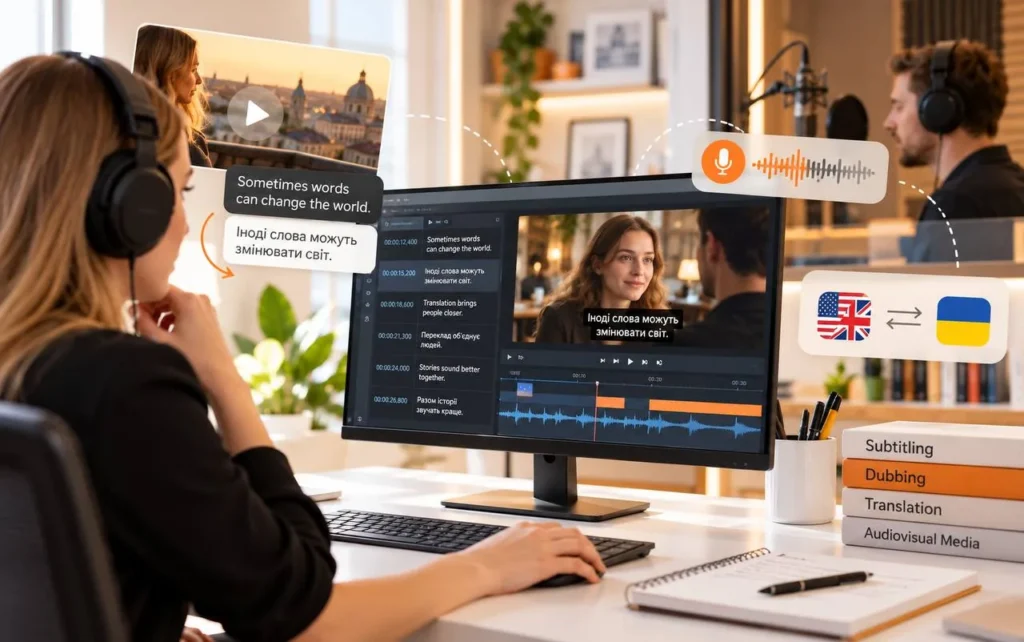

Today, video is used in situations where text used to suffice. It is used to teach, sell, present products, build a personal brand, explain complex processes, and communicate with customers.
And as soon as an author or company moves beyond a single-language audience, a logical question arises: how do you adapt an existing video for another country?
At first glance, the answer seems obvious — translate the text. But with video, it’s more complicated.
In a standard document, a translator works primarily with the content. In audiovisual translation, however, one must also take into account time, sound, editing, the pace of speech, the behavior of the subject on screen, and just how much information a viewer can actually take in within a few seconds.
A phrase that looks great on paper may prove unsuitable for subtitles. It simply won’t fit on the screen or will take too long to read.
And a grammatically flawless line may sound awkward when voiced — too formal, too slow, or unnatural.
That is precisely why audiovisual translation is not a mechanical replacement of words from one language with words from another. It is the adaptation of content to a new mode of perception.
For a blogger, this means preserving the style of communication. For an online school — the terminology and logic of the explanation. For a brand — the marketing impact. For a media platform — technical accuracy as well.
Sometimes, a well-localized video shouldn’t feel like it’s been translated at all. The viewer watches it without thinking about the translator’s work. This, in fact, is one of the key hallmarks of high-quality localization.
Subtitles, voice-over or dubbing: which to choose
There is no one-size-fits-all approach to localizing videos. The format depends on the content itself, the audience, the budget and where the video will be used.
The simplest and most flexible option is subtitles.
They work well in blogs, interviews, lectures, webinars, podcasts and training courses. Their main advantage is that the author’s original voice is preserved.
This is important if the author’s manner of speaking builds trust. For example, on a personal blog, it often feels odd to replace the author’s voice with a narrator’s completely. Subtitles allow you to retain the natural intonation, laughter, pauses and emotions.
Voice-over works differently. The translated voice is superimposed over the original.
This format is particularly useful for interviews, educational content, documentary videos and corporate materials. The viewer doesn’t need to read the text constantly — they can look at the graphics, presentation or demonstration on screen.
For online schools, this is often a very practical compromise. Full dubbing is more expensive, and subtitles aren’t always convenient, especially if there’s a lot of information on the screen.
Dubbing is the most complex format.
Here, the original audio track is effectively replaced by a new one. Lines need not only to be translated, but also adapted in terms of duration, rhythm and, in some cases, lip-sync.
This is precisely why dubbing is most often used for adverts, TV series, major educational programs and videos where it is important to create the effect of complete linguistic adaptation.
Interestingly, different formats can be used simultaneously for a single project.
For example, a main online course might feature a voice-over, short adverts might be dubbed, and additional interviews with experts might have subtitles.
In other words, the choice of format should be based not on the principle of ‘which is cheaper’, but on the principle of ‘how exactly the viewer will consume this content’.
How professional subtitles are created: from transcription to the final file
Professional subtitles begin long before the text appears at the bottom of the screen.
If there is no finished script, the first stage is transcription. It is necessary to reproduce the speech accurately, identifying names, terms, product names, abbreviations, and unclear fragments.
For a simple conversational video, this is relatively straightforward. But in a technical webinar, a single misidentified abbreviation can alter the meaning of an entire sentence.
Next comes the translation.
And this is where it gets interesting: the translator needs to think not only about what is being said, but also about how it will read on screen.
After translation, the text is broken down into blocks for subtitles.
This is not a mechanical division based on the number of characters. The phrase must remain logical. It is undesirable to move a preposition to the end of one line and a related word to the next. It is equally bad to split fixed phrases or grammatically connected parts of a sentence.
Timecodes are then set.
For each subtitle, the start and end points are determined. It is important not simply to match the dialogue ‘roughly’, but to ensure that the text sounds natural.
The next stage is to check the reading speed.
A subtitle may be perfectly translated, but if it remains on screen for only a second, it is of little use.
Therefore, some phrases have to be shortened, reworded or split up.
After this, the material must be checked against the video.
It’s one thing to see a list of lines in a file, but quite another to view them in real time. It is at this stage that it becomes apparent where a subtitle disappears too quickly, overlaps important on-screen text, or, due to editing cuts, looks odd.
The final result can be in SRT, VTT, or another format supported by the specific platform.
But a good subtitle file is not just a set of timecodes and text. It is the result of a series of decisions: what to keep, what to cut, where to split, when to display, and how much time to give the viewer.
Why subtitles shouldn’t be translated word for word
A literal translation in subtitles almost always creates one of two problems: either the text becomes too long, or it sounds unnatural.
The reason is simple — languages have different structures.
An English sentence can be very concise, whilst the Ukrainian translation may be longer. In German, the situation may be different again. Sometimes the opposite is true: a complex phrase in the source language translates into a shorter one.
This isn’t a major issue for a written document. For subtitles, however, it is critical.
For example:
“We need to figure out what went wrong before we move forward.”
Literal translation:
‘We need to find out exactly what went wrong before we can move on.’
For subtitles, it sounds more natural to say:
“Before moving forward, we need to understand what went wrong.”
The meaning remains the same, but the sentence is now shorter and easier to read.
Another issue is spoken language.
People often speak using repetitions, filler words and pauses:
‘Well, I think that, actually, we probably need to rethink this a bit.’
In subtitles, a line like this might become:
‘I think we need to rethink this.’
The information remains, but the text is clearer.
However, it’s easy to go too far here.
If a character is nervous and repeats themselves a lot for that very reason, these repetitions may be part of their personality. If the translator ‘smooths everything out’, the scene will lose its emotional impact.
That’s why professional adaptation isn’t just mindless abridgment. You need to understand what can be removed and what is part of the content or the character’s image.
Humor is even trickier.
If a joke is based on a play on words, a literal translation can render it incomprehensible. In such cases, the translator departs from the form and tries to preserve the function: if the original is meant to make the viewer smile, the translation must also work as a joke.
Number of characters on screen: where the technical side comes in
One of the most practical aspects of subtitling is the length restriction.
Professional subtitles usually consist of at most two lines. A common guideline is 35–42 characters per line, although specific requirements depend on the platform, language, and video format.
But the figure itself does not solve the problem.
Even a short subtitle can be awkward if it appears only for a split second.
Conversely, a slightly longer phrase can be read comfortably if it remains on screen for long enough.
That is why experts take into account not only the number of characters but also reading speed.
For example:
‘What I really want you to understand is that this solution won’t necessarily work for every business.’
This is too much for a short video clip.
A more natural version would be:
‘It’s important to understand: this solution won’t suit every business.’
Sometimes it’s precisely this sort of adaptation that makes a subtitle sound professional.
There’s another detail too — line breaks.
Option:
We offer professional translation services for
international online schools and platforms
is less effective than:
We offer professional translation.
for international online schools and platforms.
It may seem like a minor detail, but when there are hundreds of such lines, the quality of the reading experience depends heavily on such decisions.
Today, there’s another factor to consider — vertical video.
On Reels, TikTok and Shorts, there is less horizontal space, and the bottom of the screen is often taken up by buttons, captions and interface elements. Therefore, subtitles for horizontal video cannot always be transferred to a vertical format.
Timing and synchronization: when a single second changes perception
Timing is something the viewer rarely thinks about, provided everything is done correctly.
But they notice very quickly if something is done badly.
A subtitle that appears before the line of dialogue can accidentally ‘spoil’ a joke or a reply.
Text that appears too late forces the brain to constantly play catch-up with the dialogue.
And a subtitle that disappears too quickly doesn’t give viewers time to read it.
Every line of dialogue has a start and an end point. But in practice, good synchronization isn’t just about mechanically matching the sound wave.
There are pauses in speech. Speakers interrupt one another. A person might draw out a word or suddenly change their train of thought.
If subtitles were to react to every micro-pause, they would start to flicker.
It is particularly challenging to work with podcasts and discussions in which several people speak at the same time.
Here, it is necessary not only to set the timing but also to indicate exactly who is speaking clearly.
Dashes, speakers’ names or other markers are used — depending on the project’s style.
Another factor is editing.
Sometimes a phrase may technically remain on screen for a few tenths of a second longer, but at that moment there is a sudden change of shot. Visually, the subtitle is already perceived as part of the new scene.
Therefore, good synchronization takes into account not only the audio but also the video sequence.
How voice-overs and dubbing are created
As soon as the translation is spoken rather than read, the rules change.
A written sentence can be complex and long. The voice-over artist, however, needs to deliver it within a specific time frame and in such a way that it sounds natural.
That is why a translation for voice-over is almost always edited separately.
For example:
‘We would like to draw your attention to the fact that this opportunity is only available for a limited period of time.’
For a live voice, it sounds more natural to say:
‘Please note: this offer is valid for a limited time only.’
The meaning is the same. But the second phrase sounds much better and fits more easily into the required time slot.
In voice-over, the original voice is often left faintly audible. This helps to preserve the speaker’s emotion.
In dubbing, the requirements are stricter. The translation must more or less match the original in duration, and sometimes even approximate the character’s articulation.
This is particularly important in close-ups, where lip movement is clearly visible.
Next comes the work on the voice.
An overly theatrical delivery is unlikely to be suitable for a course. For adverts, on the other hand, a calm, monotonous voice can destroy the desired emotion.
Therefore, the choice of voice-over artist is also part of the localization process.
After recording, the audio is edited, the volume is leveled, it is cleaned up and synchronized with the video.
And only then can the result be fully assessed.
Localization: when translation becomes cultural adaptation
Words always exist within a context.
A joke that works in the US might not work in Ukraine. The name of a local retail chain might mean nothing to a viewer in Germany. And a popular meme might be completely unknown to a different audience.
This is where localization begins.
Sometimes it’s enough to explain the context a little. Sometimes it’s better to replace the example. And sometimes the original name needs to be kept because it’s important to the plot.
Style is particularly important for blogs.
If the author writes in a light, ironic, and slightly chaotic style, but the translation suddenly sounds academic, it’s as if it were written by a different person.
The same applies to online courses.
A term in a course cannot be translated in three different ways across different lessons. That’s why a glossary and a style guide are often created for large projects.
Advertising presents an additional challenge: maintaining persuasiveness.
The call to action ‘Get yours today’ can be translated in different ways depending on the product:
‘Order today’,
‘Try it right now’,
‘Choose your option’.
Here, it is more important to preserve the phrase’s function than to reproduce it literally.
Who benefits most from audiovisual translation?
For bloggers, it’s a way to scale up content they’ve already created.
Videos that remain relevant for a long time are particularly well-suited to localization: how-to guides, tutorial videos, reviews, long-form podcasts, and expert content.
For online schools, the benefit is even more obvious.
Creating a course is expensive. You need scripts, tutors, editing, presentations and tests. Localization, however, allows you to use the same product in a different market without having to produce it again.
Speed is crucial for media platforms.
A news interview, report or topical podcast cannot be left to be translated for weeks on end. What’s needed here is a process in which transcription, translation, editing and timing work as a single integrated system.
For brands and marketing agencies, localization helps to launch a single piece of advertising material across several countries.
Production companies often need translations even before editing is complete — this allows them to see straight away where a line in another language doesn’t fit the timing.
International businesses, meanwhile, require localization for corporate training courses, onboarding, instructions, presentations and internal communications.
And there’s a practical benefit here: a training video translated to a high standard once can be used for years by hundreds of employees.
Audiovisual translation at STATUS KO
At the STATUS KO Translation Center, we view videos not as ‘text with a picture’, but as a separate localization product.
Depending on the task, the work may include transcription, translation, subtitle adaptation, timing, terminology editing, preparation of SRT or VTT files, adaptation for voice-over or dubbing, and a final check of the video.
For large projects, it is particularly important to establish a workflow.
Whether it’s an online school with dozens of lessons or regular content for a media platform, it’s advisable to define the rules for translating key terms, names and style in advance.
This reduces inconsistencies and makes localization more predictable.
The platform is also important.
YouTube, an LMS, TikTok, Instagram, a corporate portal or an advertising platform may have different technical requirements.
Therefore, before starting work, it is advisable to understand exactly where the final product will be used.
And here’s another often-overlooked point: not every video requires full dubbing.
Sometimes, well-produced subtitles yield better results. Sometimes, a voice-over will be the best option in terms of value for money and convenience. Whereas for a promotional video, it makes sense to invest in a full language adaptation.
For a preliminary quote, provide the video, an audio file, a script or a link to the material, and specify the required language and preferred format.
If you already have a transcript or subtitle file, please include these as well.
STATUS KO helps localize videos for blogs, online schools, businesses, the media and international projects — from a single subtitle file to the comprehensive production of a foreign-language version.
FAQ: frequently asked questions about audiovisual translation
1. What is audiovisual translation?
It is the translation of video and audio material, taking into account not only the words but also the timing, speaking pace, visuals, intonation and requirements for display or dubbing.
2. How do professional subtitles differ from automated ones?
Automated systems can quickly produce a rough draft, but they often make mistakes with terminology, names, punctuation and context. Professional production additionally involves editing, adapting line lengths, segmentation and synchronization.
3. How many characters can a single line contain?
The exact limit depends on the platform, but a guideline of around 35–42 characters per line, with a maximum of two lines at a time, is often used.
4. Why can’t you translate the text word for word?
Because the translation may end up being longer than the original, and the viewer won’t have time to read it. Furthermore, a literal translation often fails to convey humor, slang, and conversational intonation.
5. Which is better for an online course — subtitles or a voice-over?
It depends on the format. If there are many graphics and demonstrations on screen, a voice-over is often more convenient. If it’s important to retain the tutor’s voice or the budget is limited, professional subtitles may be the best solution.
6. How does a voice-over differ from dubbing?
With a voice-over, the original voice is usually left faintly audible. With dubbing, the original audio is completely or almost completely replaced by a new audio track.
7. Is it possible to localize an existing YouTube channel?
Yes. It isn’t necessary to translate the entire archive straight away. People often start with the most popular or most relevant videos to gauge the reaction of a new audience.
8. Can AI be used to translate subtitles?
Yes, as a supporting tool. However, a professional result still requires human checking: particularly in terms of timing, terminology, natural phrasing and context.
9. What determines the cost of the work?
It depends on the video’s duration, the language pair, the subject matter, the sound quality, whether a script or transcript is available, the need to create timecodes, the need to provide voice-over or dubbing, and the turnaround time.
10. What do I need to provide for a quote?
The video, an audio file or a link to the material, the target language, and the desired output format. If you have a finished script, transcript, SRT or VTT file, it is also advisable to include these.